There are no items in your cart
Add More
Add More
| Item Details | Price | ||
|---|---|---|---|

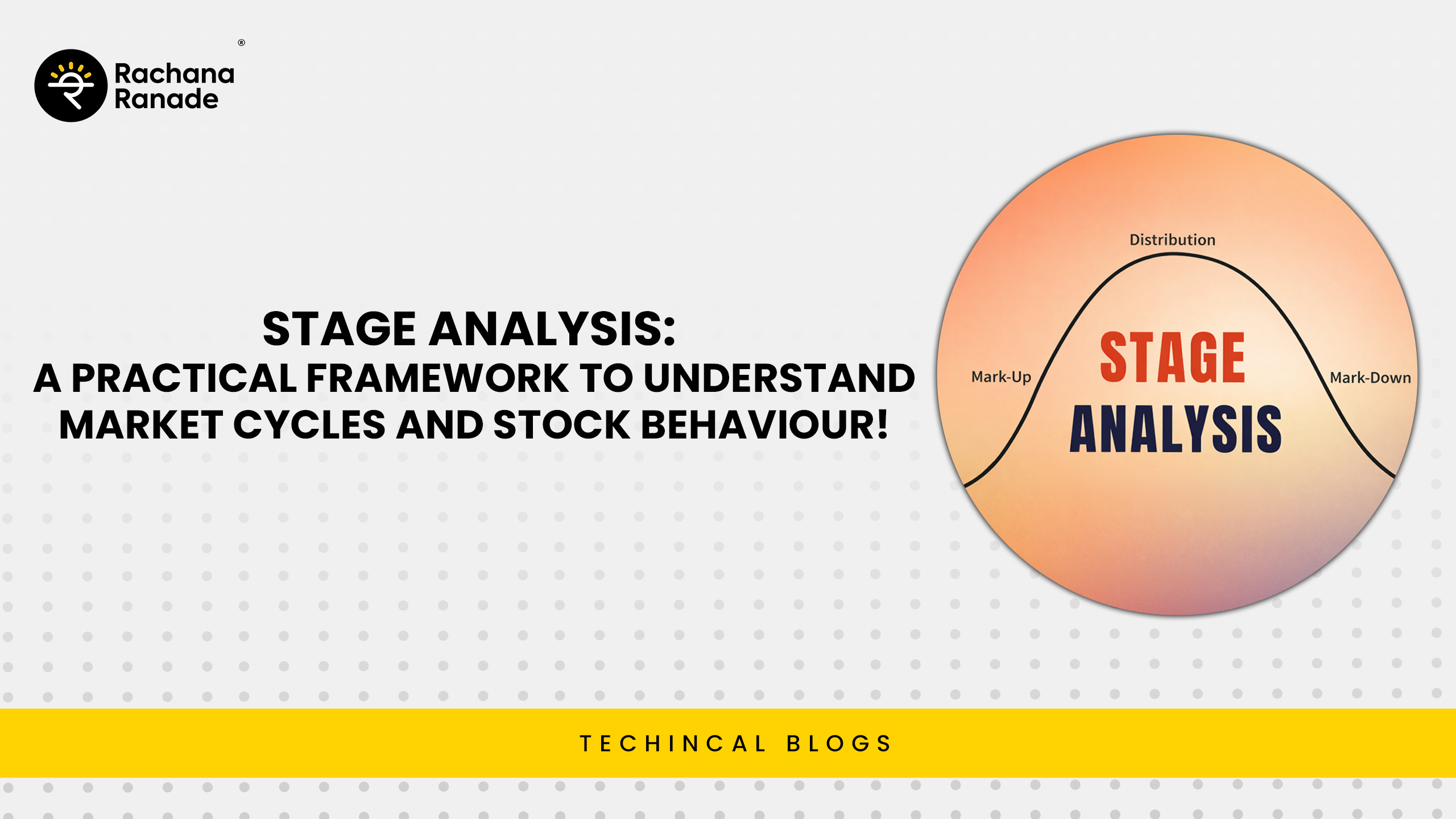
How to identify where a stock stands in its life cycle and position yourself accordingly.
What Is Stage Analysis?
Stage analysis is a market framework popularised by Stan Weinstein that explains how stocks and markets move through predictable phases over time. Instead of reacting to short term price moves, stage analysis helps investors understand the broader structure of a stock’s trend and align their strategy with it.The core idea is simple. Stocks do not move randomly. They transition through phases of accumulation, advance, distribution, and decline. Each stage reflects a different balance between demand and supply and offers different risk reward characteristics.
The Four Stages of a Stock
Stage 1 Base Building
This is the accumulation phase. After a prolonged fall, the stock stops making new lows and starts moving sideways. Volatility reduces and volumes often dry up. Large investors slowly accumulate without pushing prices higher.
This stage is marked by uncertainty. The business might still look weak on headlines, but selling pressure has largely exhausted itself. For long term investors, this is where future leaders are quietly prepared, but confirmation is still missing.
Stage 2 Advancing Trend
This is the strongest and most rewarding phase. The stock breaks above its long term resistance and begins making higher highs and higher lows. Moving averages start sloping upward and volume expands on up moves.
This stage reflects growing confidence in the business. Earnings improve, narratives strengthen, and institutional participation increases. From a risk reward perspective, this is the most favourable stage to participate in.
Stage 3 Topping or Distribution
Here, momentum slows down. The stock still trades near highs but struggles to move meaningfully higher. Volatility increases and rallies are often sold into. Volumes rise without corresponding price progress, indicating distribution by informed players.
This stage is dangerous because price may still look strong, but internal strength is weakening. Investors who confuse Stage 3 for consolidation often overstay their positions.
Stage 4 Declining Trend
This is the breakdown phase. The stock falls below key supports and long term moving averages turn downward. Lower highs and lower lows become visible. Bad news accelerates declines, and investor confidence erodes.
This stage destroys capital quickly. The priority here is capital protection, not bargain hunting.
How to Identify Which Stage a Stock Is In?
The most practical tool for stage analysis is the 30 week or 200 day moving average.
In Stage 1, price moves sideways around a flat moving average.
In Stage 2, price stays above a rising moving average.
In Stage 3, price oscillates around a flattening moving average.
In Stage 4, price remains below a falling moving average.
Volume behaviour adds confirmation. Rising volume on up moves supports Stage 2. Rising volume on down moves confirms Stage 4. Price structure, not indicators, should always be the primary guide.
Why Stage Analysis Matters?
Most investors lose money not because they choose bad companies, but because they enter them at the wrong stage. Buying a great business in Stage 4 can still lead to years of underperformance. Stage analysis aligns behaviour with market reality rather than opinion.
It also brings discipline. You know when to focus on accumulation, when to ride trends, when to book profits, and when to stay out entirely.
Try This Yourself
Below are two stocks. Pull up their daily or weekly charts and identify which stage they are currently in using price structure and the long term moving average.
1. Garden Reach Shipbuilders & Engineers Ltd
2. BSE Ltd
This exercise builds visual conviction far better than theory alone.
Conclusion
Stage analysis is not about predicting the future. It is about recognising where you are in the cycle and acting accordingly. Markets reward alignment, not intelligence.
By consistently investing in Stage 2 stocks and avoiding Stage 4 traps, investors can significantly improve outcomes without increasing complexity. Over time, this simple framework can act as a powerful filter that protects capital and lets winners run.